Salesforce Announces Deep Observability for AI Agents

November 21, 2025
693 Views
Salesforce Announces Deep Observability for AI Agents

AI agents are a fundamental layer of business now, but in the absence of good observability teams can observe what an agent did, but not how it decided to do it. Things that work well in tests are often obscured in real interactions with customers, making it harder to improve performance or build trust.

Salesforce has figured this out with advanced observability tools that show how every agent thinks, what it does and how it makes decisions. Rather than a black box, the whole system is transparent and auditable, providing the visibility needed to operate AI safely and at scale.

What Is Agent Observability in Salesforce?

Agent Observability in Salesforce lets you see what’s happening inside your AI agent during every interaction. Instead of only showing the final answer, it reveals the full thinking process, how the agent understood the question, what steps it followed, and why it chose a specific response.

This visibility is important because AI agents constantly learn and change. Without it, you can’t be sure they’re following business rules or giving accurate, safe outputs. Salesforce’s observability tools make everything clear, so you can understand decisions, fix issues quickly, and keep performance strong.

By turning AI behavior into simple, readable insights, Salesforce helps businesses build more trustworthy agents and scale AI with confidence.

Why are Agent Observability Tools Essential?

With AI adoption increasing rapidly and 48% of organizations expecting more agentic AI projects this year. But the excitement comes with a reality check: scaling AI across an enterprise requires visibility. Teams need a constant view of how agents are learning, performing, and evolving, especially when they are handling real customer interactions that influence revenue, satisfaction, and operational efficiency.

In today’s agent-driven world, “seeing is believing.” Observability transforms uncertainty into transparency by giving teams measurable data about an agent’s decisions and behavior.

And as Adam Evans, EVP & GM of Salesforce AI, puts it, “You can’t scale what you can’t see.”

This new generation of tools gives leaders the confidence to track performance, debug issues, and justify AI investments with clear ROI.

Also Read

Don’t forget to checkout: Agentforce Vibes: Your AI Partner for Salesforce Coding.

What’s New: Deep Observability in Agentforce

Salesforce’s new observability suite focuses on three core areas that work together to provide continuous insight and operational reliability.

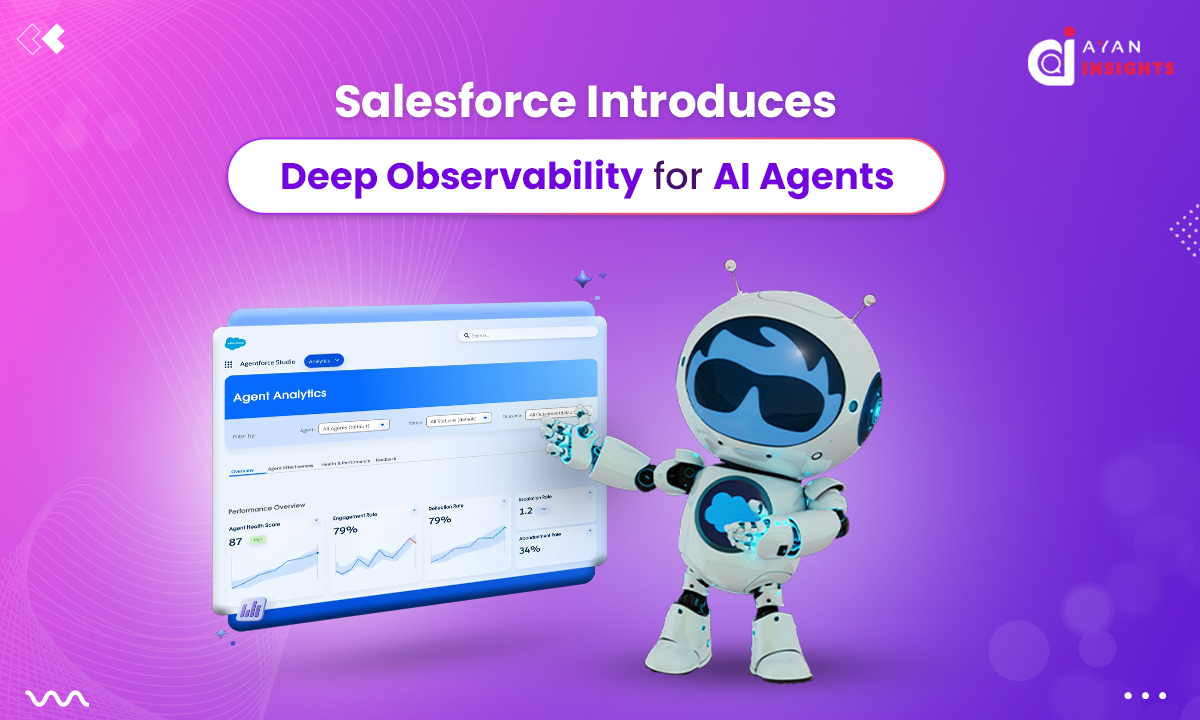
  1. Agent Analytics – Turning Performance Into Insights

    Agent Analytics offers a full picture of how every deployed agent is performing in real interactions. It highlights:

    • Usage and effectiveness metrics across the agent fleet
    • KPI patterns and trends to surface improvements or declines
    • Actionable insights to identify weak topics, flows, or decisions

    These insights help teams make informed updates and refine performance over time.

  2. Agent Optimization – Full Traceability and Reasoning Clarity

    Where analytics shows what is happening, optimization explains why it’s happening.

    Agent Optimization allows teams to:

    • Trace every interaction step by step, including complex reasoning chains
    • Cluster similar sessions to identify common issues and emerging patterns
    • Score responses using intent, topic, and quality metrics
    • Spot configuration gaps, enabling precise tuning or guardrail adjustments

    This level of insight makes troubleshooting far more efficient, accelerating both improvement and trust.

  3. Agent Health Monitoring – Uptime, Alerts, and Reliability

    To run AI at scale, reliability is non-negotiable. Health Monitoring provides:

    • Continuous, near-real-time agent status tracking
    • High-speed error and latency alerts to prevent service disruptions
    • Proactive failure detection to reduce downtime
    • Enterprise-grade reliability even during peak demand

    These capabilities ensure agents remain stable, responsive, and trustworthy at all times.

How Salesforce Unifies Agent Governance and Deep AI Agent Observability

Salesforce has built this observability layer on two key foundations

Session Tracing Data Model

This model logs every detail, user inputs, LLM calls, guardrails, reasoning steps, and stores them in Data 360. It gives teams complete session-level visibility to ensure agents operate exactly as intended.

MuleSoft Agent Fabric

A centralized governance layer where companies can register, manage, monitor, and control all agents, regardless of how or where they were created.

By combining Session Tracing, Agent Fabric governance, and Data 360 context, Salesforce enables organizations to maintain full oversight and operational consistency across their growing agent ecosystem.

Final Thoughts

As companies expand their use of AI agents, the challenge isn’t just creating them, it’s managing them intelligently at scale. Salesforce’s new observability tools deliver the visibility, trust, and operational rigor required to build a reliable network of agents that can make real business decisions.

With this new layer of transparency, organizations can confidently move toward the vision of the Agentic Enterprise, where humans and AI agents work side by side with clarity, accountability, and measurable impact.

How useful was this post?

Click on a star to rate it!

Average rating 0 / 5. Vote count: 0

No votes so far! Be the first to rate this post.

Written by

Mohit Bansal

Salesforce Technical Architect | Lead | Salesforce Lightning & Integrations Expert | Pardot | 5X Salesforce Certified | App Publisher | Blogger

Get the latest tips, news, updates, advice, inspiration, and more….

Contributor of the month
contributor
Ila Anmol Verma

Salesforce Tech Lead | 12X Salesforce Certified | Technical Writer

...
Categories
...
Boost Your Brand's Visibility

Want to promote your products/services in front of more customers?

...

Leave a Reply

Your email address will not be published. Required fields are marked *