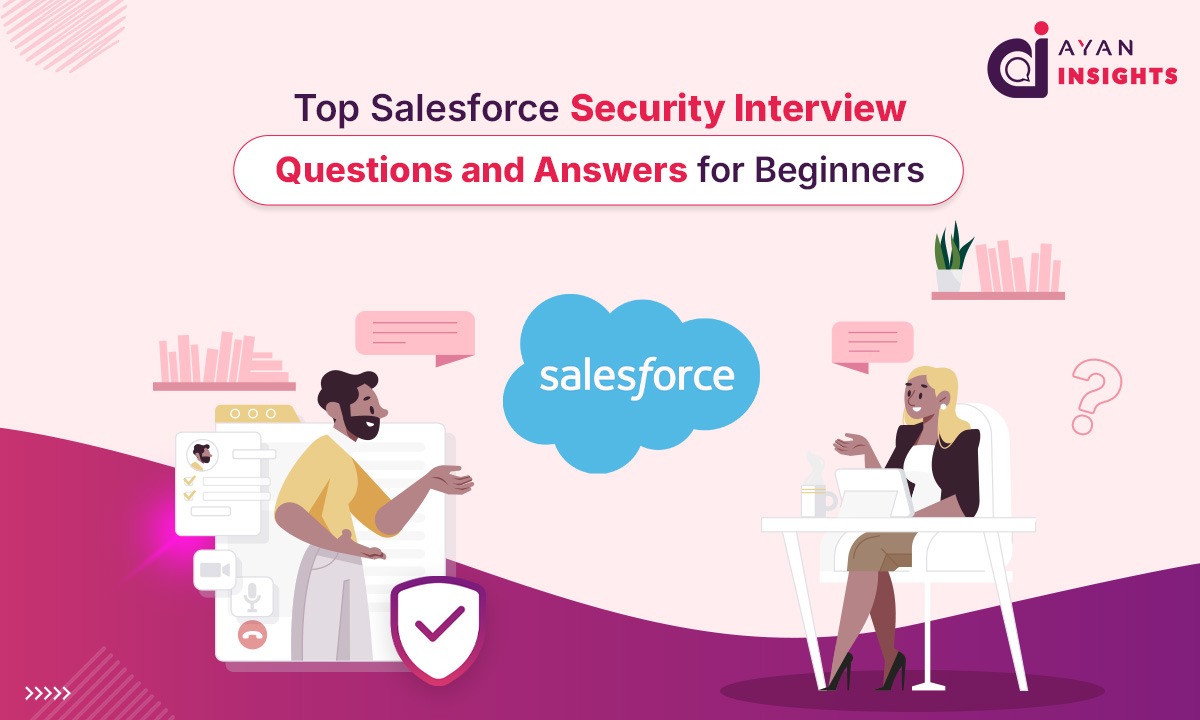
Top Salesforce Security Interview Questions and Answers for Beginners

May 22, 2026
7 Views
Top Salesforce Security Interview Questions and Answers for Beginners
Summarize this blog post with:

Preparing for a Salesforce interview can feel overwhelming, especially when it comes to Salesforce Security. It is one of the most important topics for Admin, Developer, Consultant, and Architect roles because companies want professionals who understand how to protect sensitive business data and manage secure access within Salesforce.

In most interviews, recruiters do not just ask theoretical questions. They expect candidates to explain real-world scenarios involving Profiles, Permission Sets, OWD, Sharing Rules, Field-Level Security, Role Hierarchy, MFA, and Salesforce Shield. Having strong knowledge of the Salesforce Security Model can help you stand out from other candidates and confidently answer scenario-based interview questions.

To help you prepare better, we have compiled some of the most commonly asked Salesforce Security Interview Questions and Answers along with practical examples and best practices. Whether you are a beginner preparing for your first Salesforce Admin interview or an experienced professional looking to refresh your concepts, these questions will help you build a strong understanding of Salesforce Security.

Q1. What are the different levels of security in Salesforce?

Answer:
Salesforce security is divided into four major levels:

1.Organisation-Level Security
  • Controls login access, IP restrictions, password policies, MFA, and login hours.
2.Object-Level Security
  • Controls CRUD permissions (Create, Read, Edit, Delete) using Profiles and Permission Sets.
3.Field-Level Security (FLS)
  • Controls visibility and editability of fields.
4.Record-Level Security
  • Controls which individual records users can access using:
    • OWD
    • Role Hierarchy
    • Sharing Rules
    • Manual Sharing
    • Apex Sharing

Q2. What is Organisation-Wide Default (OWD)?

Answer:

OWD defines the baseline level of record access for users in Salesforce.

Common OWD settings:

  • Private
  • Public Read Only
  • Public Read/Write
  • Controlled by Parent

Example:

If Opportunity OWD is set to Private, users can only see records they own unless additional sharing is provided.

Q3. What is the difference between Profiles and Roles?

Feature Profile Role
Controls Object & Field permissions Record visibility
Mandatory? Yes No
User Count One profile per user One role per user
Purpose What can a user do What records can the user see

Example:

A Sales Rep and Sales Manager may have the same Profile but different Roles.

Q4. What is Field-Level Security (FLS)??

Answer:

Field-Level Security controls whether a user can:

  • View a field
  • Edit a field

Even if the user has object access, FLS can still hide fields.Example:

If Opportunity OWD is set to Private, users can only see records they own unless additional sharing is provided.

Q5. What is the difference between Page Layout Security and Field-Level Security?

Page Layout Field-Level Security
Hides the field only on the UI Restricts the field everywhere
Not secure Fully secure
Field accessible via API Field inaccessible via API

Best Practice:

Use FLS for security, Page Layouts only for UI customisation.

Q6. What are Permission Sets?

Answer:

Permission Sets extend user permissions without changing Profiles.

A user:

  • Can have only one Profile
  • Can have multiple Permission Sets

Use case:

Grant temporary access to the Product object for Marketing users.

Q7. What is the difference between Profiles and Permission Sets?

Profile Permission Set
Mandatory Optional
One per user Multiple per user
Baseline access Additional access
Less flexible Highly flexible

Modern Salesforce best practice recommends:

  • Minimal Profiles
  • Permission Sets + Permission Set Groups

Q8. What are Sharing Rules in Salesforce?

Answer:

Sharing Rules automatically extend record access to users.

Types:

  1. Owner-Based Sharing Rules
  2. Criteria-Based Sharing Rules

Example:

Share all APAC Accounts with the APAC Sales Team.

Q9. What is Role Hierarchy?

Answer:

Role Hierarchy gives managers access to records owned by subordinates.

Example:

Sales Manager can access Opportunities owned by Sales Reps below them.

It works together with OWD.

Q10. What is Manual Sharing?

Answer:

Manual Sharing allows record owners to share individual records with specific users or groups manually.

  • Private
  • Public Read Only
  • Public Read/Write
  • Controlled by Parent

Example:

A user shares a single Opportunity with another teammate.

Q11. What is Apex Sharing??

Answer:

Apex Sharing is programmatic sharing using Apex code.

Used when standard sharing rules cannot handle complex business logic.

Example:

Automatically share records with users based on custom conditions.

Q12. What are “View All” and “Modify All”?

Permission Description
View All The user can see all records.
Modify All The user can edit/delete all records.
These permissions ignore sharing rules and OWD.

Q13. What is “Grant Access Using Hierarchies”?

Answer:

This setting allows users higher in the role hierarchy to automatically access records owned by users below them.

It is enabled by default for standard objects.

Q14. What is the difference between Public Group and Queue?

Public Group Queue
Used for sharing Used for record ownership
Can contain users/roles Holds records
Used in sharing rules Used in assignment rules

Q15. What is a Permission Set Group?

Answer:

Permission Set Group combines multiple Permission Sets into one reusable bundle.

Example:

Sales Persona PSG may contain:

  • Opportunity Access
  • Lead Access
  • Reports Access

Best practice in modern Salesforce security architecture.

Q16. What is the Muting Permission Set?

Answer:

Muting Permission Set removes permissions from a Permission Set Group.

Useful when:

  • Most users need access
  • Some users require restricted access

Q2. What is Organisation-Wide Default (OWD)?

Answer:

Users should receive only the minimum permissions required to perform their job.

Best practice:

  • Minimal Profiles
  • Modular Permission Sets
  • Private OWD whenever possible

Q18. What is Multi-Factor Authentication (MFA)?

MFA adds an extra authentication step beyond password login.Examples:

  • Salesforce Authenticator
  • OTP
  • Security Key

Salesforce recommends MFA for enhanced security.

Q19. What are Login IP Ranges and Login Hours?

Login IP Ranges

Restrict users to login only from approved networks.

Login Hours

Restrict users to login only during allowed business hours.
Configured at the Profile level.

Q20. Scenario: User Cannot See a Field. How Would You Troubleshoot?

Answer:

Check in this order:

  1. Field-Level Security
  2. Permission Sets
  3. Page Layout
  4. Record Access
  5. Object Permissions

Most common issue:

Field hidden via FLS.

Also Read

Conclusion

Salesforce Security is the foundation of every successful Salesforce implementation. A strong understanding of Profiles, Roles, Permission Sets, Sharing Rules, OWD, Field-Level Security, and advanced security concepts helps professionals design secure and scalable Salesforce environments.

In interviews, employers often look for candidates who can explain not only the technical concepts but also how they apply them in real business scenarios. That is why practising Salesforce Security Interview Questions and Answers is one of the best ways to improve your confidence and problem-solving skills before an interview.

We hope these Salesforce Security interview questions help you strengthen your preparation and gain a deeper understanding of Salesforce’s security architecture. Keep practising scenario-based questions, stay updated with the latest Salesforce security best practices, and focus on explaining concepts in a simple and practical way during interviews.

How useful was this post?

Click on a star to rate it!

Average rating 0 / 5. Vote count: 0

No votes so far! Be the first to rate this post.

Written by

Priya Bansal

Salesforce Technical Architect - Lightning (Aura & LWC) Specialist | Pardot | Salesforce Integrations | Sales/Service/Community Cloud Expert | Salesforce Apps (AppExchange) Developer

Get the latest tips, news, updates, advice, inspiration, and more….

Contributor of the month
contributor
Antonina Kharchenko

Technical Writer, Salesforce Admin at SFApps.info

...
Categories
...
Boost Your Brand's Visibility

Want to promote your products/services in front of more customers?

...

Leave a Reply

Your email address will not be published. Required fields are marked *