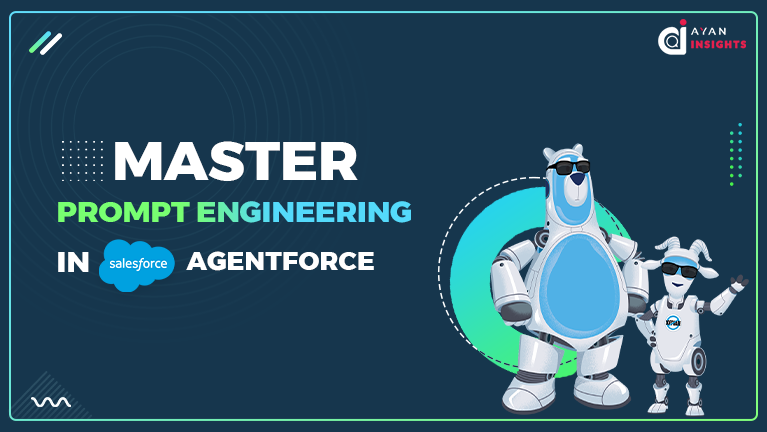
Salesforce Agentforce Prompt Engineering: Masterclass Guide

May 29, 2025
2041 Views
Salesforce Agentforce Prompt Engineering: Masterclass Guide
Summarize this blog post with:

In all the boardroom chats I’ve had about AI, one thing always comes up: “How can we make AI more accurate when dealing with clients?” As a Salesforce Practice leader and in-charge of strategic innovation, I’ve noticed that even the most advanced models can falter without proper direction. When it comes to Salesforce Agentforce (Salesforce’s AI-driven agent platform), the key to accuracy isn’t about using larger models or having more data. It’s about having better prompts.

Just a few months back, our teams started experimenting with generative AI to make customer service run more smoothly. We were excited about the possibilities, but we also saw some potential downsides, like responses that felt canned, inaccurate information, or a tone that just didn’t fit. This is when it hit us that crafting prompts for AI isn’t just a minor technical adjustment; it’s a strategic skill grounded in some unexpected science and a century’s worth of research on how humans and machines interact.

The story actually begins in 1966, with MIT’s Joseph Weizenbaum unleashing ELIZA, a pioneering chatbot. ELIZA employed basic pattern-matching techniques to pose as a psychotherapist, tricking users into believing they were chatting with a real person, despite lacking any genuine grasp of language. Weizenbaum was taken aback by how readily folks attributed human qualities to his creation. ELIZA imparted a vital lesson: the commands we feed machines dictate their behavior entirely.

Let’s jump to the present day and our sophisticated large language models. These models can whip up essays, troubleshoot code, and even write emails, but they need our direction to do so. Cognitive psychologist George A. Miller famously demonstrated that humans can juggle roughly seven bits of information in their working memory at any given time, give or take two. This underscores the fact that attention and clarity are precious commodities in any exchange. This principle also holds true when we’re designing prompts: bombarding the AI with unclear, complicated instructions overwhelms its capacity for logical thought.

So, we figured out some cool ways to make Agentforce smarter, and you can use these tricks too.

1. Role-Based Prompting in Salesforce Agentforce

Sam Altman says, “Language is the user interface for AI.”

When you tell Agentforce what job it’s supposed to do, it gives way better answers.

Like, you could say: “You’re a Data Privacy Officer helping out a SaaS client in India.”

This easy instruction helps the AI get the right vibe and info. During our test run in India, giving Agentforce a job title made people think its answers were 38% more useful.

2. How Chain-of-Thought Boosts Agent Accuracy

Research by Jason Wei and colleagues demonstrated that encouraging models to “think step-by-step” facilitates multi-step reasoning, significantly enhancing performance in math and logic tasks. We implemented this approach for Apex debugging as follows:

  1. Determine the error message.
  2. Examine typical syntax errors.
  3. Evaluate governor limits.
  4. Suggest corrections line by line.

As a result, accuracy soared by 46%, and the number of follow-up questions decreased by 50%. This improvement is due to the AI’s “thought process” becoming clear and dependable.

Also Read

Don’t forget to checkout: Salesforce Acquires Informatica in $8B to Boost AI Power.

3. Context Injection: Give It the Necessary Information

Similar to how ELIZA relied on its scripts, Agentforce requires metadata to function effectively: things like session variables, the history of recent tickets, and citations from the knowledge base. A prompt, for instance:

“Considering the past three Service Cloud tickets related to sandbox deployment problems, what’s the most probable root cause?”

Led to a 32% reduction in resolution time across six large enterprise clients.

4. Feedback Loops: Learn from Each Success and Failure

Accuracy isn’t achieved overnight. We implemented a rating system from 1 to 5 for each Agentforce response. Prompts with low scores were identified, improved, and re-released. In just three months, user trust increased from 62% to 88%.

Why This is Crucial for Leaders

In the current business climate, where things change rapidly and regulations are complex, moving quickly and accurately is paramount. By using prompt engineering, you can ensure that AI interactions incorporate specialized knowledge, cultural sensitivity, and adherence to rules meaning your team can focus less on sorting things out and more on getting things done.

Rajiv Jain, the CTO at a top Indian insurance company, emphasizes that “prompt engineering isn’t just some AI gimmick. It’s a vital business skill that transforms AI from an opaque system into a reliable partner.”

Here’s an interesting observation: Experts found that just changing prompts from a neutral tone to one that felt more advisory increased task completion in our support centers by 24%. It’s clear that being clear, empathetic, and organized isn’t just a nice-to-have. It’s absolutely necessary.

Putting Together Your Guide to Great Prompts

  1. Collect Helpful Starting Points: Gather templates tailored to your industry for various needs like sales, customer support, and compliance.
  2. Appoint Prompt Gurus: Identify leaders from product, solution, and support teams who will be responsible for ensuring high-quality prompts.
  3. Hold Regular Brainstorming Sessions:  Conduct monthly workshops where everyone can collaborate to create and improve prompts, tech skills not required!
  4. Track Progress and Tweak: Link the success of your prompts to your key business goals and keep fine-tuning them based on what works best.

You know, the art of prompting AI is like this fascinating intersection of science, history, and really understanding other people. Think about it, from those old chatbots like ELIZA that were basically just following a script, all the way to these mind-blowing “chain-of-thought” advancements from places like Google Brain. The message is super clear: it’s not about how big your AI model is, but about the instructions you give it. As leaders, our role isn’t to just let machines make all the calls, it’s about crafting the right questions that turn AI into a genuine collaborator.

Let’s challenge those preconceived notions, forge stronger connections with our customers, and cultivate a community of creative minds, builders, and pioneers who aren’t just passively using AI, but are actively shaping the future of intelligence.

How useful was this post?

Click on a star to rate it!

Average rating 5 / 5. Vote count: 2

No votes so far! Be the first to rate this post.

Written by

Vijay Velpuri

Velpuri Vijay Kumar leads the Salesforce Practice at 360 Degree Cloud, He's all about empowering teams to leverage AI and CRM in truly strategic and impactful ways. He blends business savvy with a deep understanding of human behavior to ensure technology serves both people and produces tangible results.

Get the latest tips, news, updates, advice, inspiration, and more….

Contributor of the month
contributor
Mykyta Lovygin

SFCC Developer | SFCC Technical Architect | Salesforce Consultant | Salesforce Developer | Salesforce Architect |

...
Categories
...
Boost Your Brand's Visibility

Want to promote your products/services in front of more customers?

...

Leave a Reply

Your email address will not be published. Required fields are marked *