What AI Data Failures in Salesforce Taught Me About Business Adoption

May 01, 2026
6 Views
What AI Data Failures in Salesforce Taught Me About Business Adoption
Summarize this blog post with:

When AI Gets It Perfectly Wrong

This is not a story about AI Data malfunctioning. It is not a story about a system failing, a vendor letting us down, or a developer writing bad code. This is a story about something far more common — and far more preventable.

It is a story about what happens when a business invests in powerful AI tooling, deploys it with confidence, and then discovers that the outputs are fundamentally wrong — not because the AI was broken, but because the data it trusted was broken.

As a Business Analyst working across Salesforce implementations and AI adoption programmes, I have seen this pattern more than once. The technology works exactly as designed. The problem is the foundation it was built on.

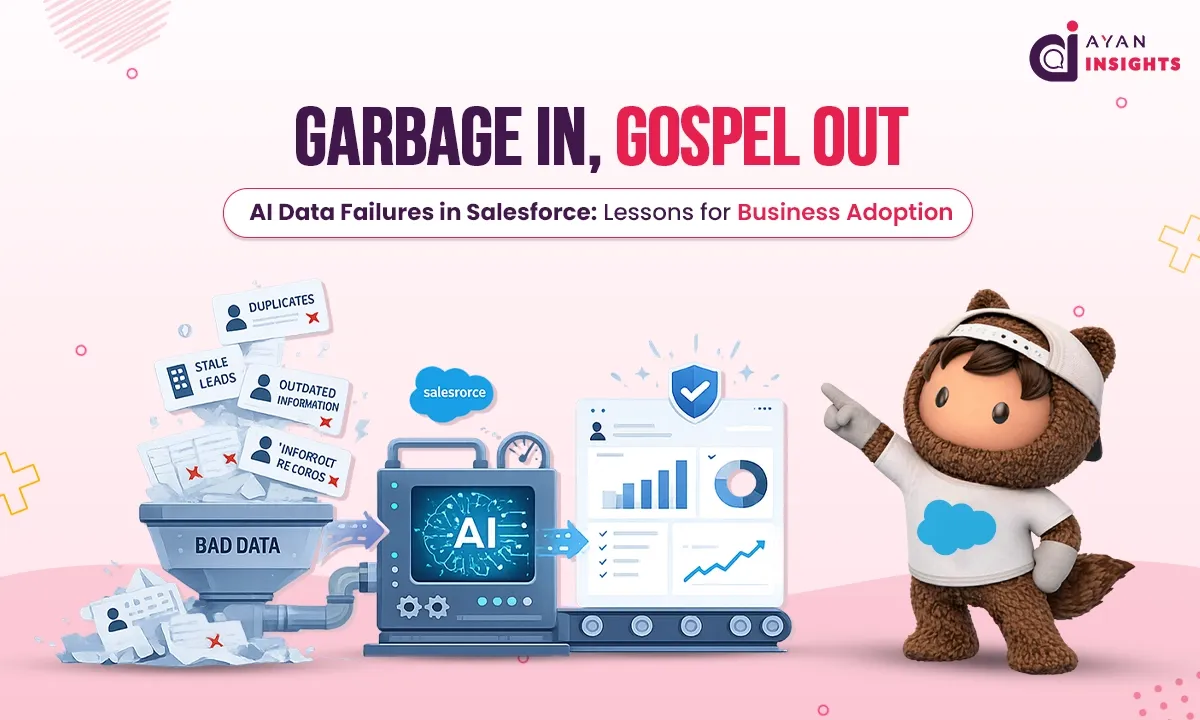
The title of this article comes from a presentation I delivered at a Salesforce Community Event. The phrase is simple: Garbage In, Gospel Out. If you feed an AI system corrupt, outdated, or unvalidated data, it will process that data perfectly — and produce outputs that are treated as ground truth.

“The AI didn’t malfunction. It did exactly what it was built to do — and got it perfectly wrong.”

THE SCENARIO

Setting the Scene

A mid-sized organisation had recently gone live with Salesforce AI features. The rollout had executive sponsorship, a defined timeline, and visible enthusiasm from the sales leadership team. Dashboards were automated. Forecasts were generated. Account summaries were live.

On paper, the adoption was a success. The system was being used. The reports were being read. Decisions were being made.

Sales Activity The sales team spent a portion of their quarter pursuing leads that had no active interest, some of which had not engaged in over two years.
Strategic Decision Making A product investment decision was informed by AI analysis based on three-year-old behavioural data — a pattern that no longer reflected the market.
Stakeholder Trust When errors were identified, trust in the AI tooling dropped significantly — making future adoption harder to advocate for.

ROOT CAUSE ANALYSIS

What We Found in the CRM

A structured data audit revealed the following issues — all of which were pre-existing at the time of AI deployment:

  • Duplicate contact records — the same individual existed under multiple entries, some with conflicting job titles and email addresses
  • Stale lead records from 2019 — still marked as active and high-priority within the pipeline
  • Double-logged closed-won opportunities — inflating pipeline value and distorting forecast accuracy
  • Accounts linked to office locations that no longer existed — triggering incorrect territory and routing logic
  • A contact still listed as an Intern — who had since been promoted to Chief Financial Officer at the client organisation
  • Dead accounts tied to live opportunities — creating AI-generated recommendations based on non-existent relationships

None of these issues were new. They had accumulated over years of inconsistent data entry, lack of governance, and the absence of any formal data ownership model. They were invisible until the AI began treating each record as fact.

BUSINESS IMPACT

The Downstream Consequences

The consequences were not theoretical. They were operational and measurable:
Impact Area What Happened
Revenue Forecasting Pipeline forecasts were materially incorrect due to duplicate records and stale opportunities. Leadership made resourcing decisions based on inflated numbers.
Customer Segmentation AI-generated segments included contacts who had changed roles, companies, or were no longer relevant — resulting in misdirected outreach.
Sales Activity The sales team spent a portion of their quarter pursuing leads that had no active interest, some of which had not engaged in over two years.
Strategic Decision Making A product investment decision was informed by AI analysis based on three-year-old behavioural data — a pattern that no longer reflected the market.
Stakeholder Trust When errors were identified, trust in the AI tooling dropped significantly — making future adoption harder to advocate for.

ORGANISATIONAL DYNAMICS

The Blame Game — and Why It Misses the Point

When the issues surfaced, the response followed a predictable pattern. Each team pointed to another as the source of the problem:

  • IT attributed the data quality issues to users who failed to maintain records consistently
  • Business users noted they had never been trained on why data hygiene mattered or what the downstream impact would be
  • Management stated they had assumed the platform would flag or correct data quality issues automatically

The reality was that nobody had defined what good data looked like before the AI was deployed. There were no data quality standards. There was no ownership model. There was no governance framework. There was no acceptance criterion that required data to be validated before AI features were switched on.

This is not an unusual situation. In many organisations, data quality is treated as a background concern — something that will be resolved over time, or that the system will self-correct. When AI is introduced, that assumption is exposed immediately.

LESSONS LEARNED

Five Lessons Every BA Should Know Before AI Goes Live

The following lessons are drawn directly from this experience. They are written for Business Analysts, Product Owners, and anyone responsible for bridging the gap between business requirements and technology delivery.

1. Data Readiness Must Precede AI Deployment

WHAT WENT WRONG

AI was deployed without a formal data quality audit. Existing CRM records were accepted as reliable without validation. The system had no baseline standard to measure quality against.

THE LESSON

Establish a data readiness checklist before any AI feature is enabled. Define what “clean” means for each object (Account, Contact, Lead, Opportunity). Run the audit before go-live, not after.

2. Every Data Object Needs a Named Owner

WHAT WENT WRONG

No individual or team was accountable for the accuracy of Contact, Account, or Lead records. Without ownership, hygiene degrades silently over time.

THE LESSON

Assign a named data owner per Salesforce object. This does not need to be a technical role. It is a business accountability — someone who reviews, escalates, and maintains the quality of that record type.

3. Input Standards Are Not Optional

WHAT WENT WRONG

The data model allowed free-text fields, missing mandatory values, and unconstrained picklists. Garbage entered the system because nothing prevented it from doing so.

THE LESSON

Use validation rules, mandatory fields, and picklist controls to enforce input standards at the point of entry. If the model allows bad data in, AI will treat it as truth.

4. Users Must Understand the ‘Why’ — Not Just the ‘How’

WHAT WENT WRONG

Users had been trained on how to use Salesforce, but not on the downstream impact of inaccurate data. Without context, data hygiene feels like administrative overhead rather than business-critical behaviour.

THE LESSON

Change management and training must include the “why”. Show users a broken AI recommendation caused by bad data. When they see the business cost of inaccurate data, behaviour changes.

5. Data Quality Must Be a Definition of Done

WHAT WENT WRONG

User stories for the AI features had no acceptance criteria related to data quality. Features were signed off without any requirement that the underlying data be validated.

THE LESSON

Every BA-authored story that involves AI or automated output should include an explicit data quality criterion. If the data is not clean, the story is not done. This is a release condition, not a suggestion.

PRACTICAL FRAMEWORK

A BA Framework for AI-Ready Data

Based on this experience, I recommend the following framework for any Salesforce BA preparing an organisation for AI adoption:

  1. Audit first. Run a structured data quality audit across all objects the AI will interact with before enablement.
  2. Define standards. Document what a clean record looks like for each object — minimum required fields, valid values, acceptable data age.
  3. Assign ownership. Map each object to a named business owner responsible for ongoing governance.
  4. Harden the model. Implement validation rules and input controls to prevent bad data from entering the system.
  5. Train on impact. Build data quality context into every user training programme — not just process walkthroughs.
  6. Gate on quality. Include data readiness as a formal acceptance criterion in every AI-related user story.
  7. Review regularly. Schedule quarterly data quality reviews as a standing item in your Salesforce governance model.

CLOSING THOUGHTS

The Question Every Team Should Be Asking

AI is not a shortcut to insight. It is an amplifier. If the data it receives is accurate, timely, and well-governed, the outputs will be valuable. If the data is inconsistent, stale, or unvalidated, the outputs will be confidently, systematically wrong.

The most important question a Business Analyst can ask before any AI feature goes live is not technical. It is not about the model, the algorithm, or the integration. It is this:

“Who has validated the data this AI is going to trust?”

If nobody can answer that question clearly, the AI is not ready to go live. More importantly — the organisation is not ready.

Data quality is not the responsibility of IT. It is not the responsibility of the vendor. It is a shared organisational discipline — and the Business Analyst is often the best-placed person to make it a requirement.

Adoption without data readiness is not transformation. It is a faster way to fail.
Also Read

Summary Card

Key Takeaways at a Glance

The Core Principle

AI amplifies what it receives. Clean data produces reliable insight. Poor data produces confident, systematic error. There is no middle ground.

The Five Lessons
  • Audit data before AI deployment
  • Assign named data owners per object
  • Enforce input standards in the data model
  • Train users on why data quality matters
  • Make data quality a formal acceptance criterion
The Question to Ask

“Before your next AI feature goes live — who checked the data?”

How useful was this post?

Click on a star to rate it!

Average rating 0 / 5. Vote count: 0

No votes so far! Be the first to rate this post.

Written by

Kam Matharu

Kam Matharu is a Lead Salesforce Consultant at Capgemini and community leader passionate about giving back. Through Kam’s Tech Talk & Punjabiforce, he mentors and supports individuals in building successful careers in Salesforce and technology.

Get the latest tips, news, updates, advice, inspiration, and more….

Contributor of the month
contributor
Mykyta Lovygin

SFCC Developer | SFCC Technical Architect | Salesforce Consultant | Salesforce Developer | Salesforce Architect |

...
Categories
...
Boost Your Brand's Visibility

Want to promote your products/services in front of more customers?

...

Leave a Reply

Your email address will not be published. Required fields are marked *