Salesforce Stock Is Recovering: Can Q2 Keep the Momentum Going?

August 20, 2026
21 Views
Salesforce Stock Is Recovering: Can Q2 Keep the Momentum Going?
Summarize this blog post with:

If you’ve never bought a stock in your life, and words like Q2 earnings or P/E ratio mean nothing to you, don’t worry. This blog is written for you- no assumptions, just a simple, honest explanation of what is happening with Salesforce right now. First, Let’s Understand What’s Going On. Salesforce is a huge American software company. Businesses all over the world pay Salesforce every month, kind of like a Netflix subscription, to use its software for managing customers, sales, and now AI tools too.

Because Salesforce is a public company, anyone can buy a small piece of it. This is called buying a stock or a share. When people think the company is doing a job and will get even better, they want to buy the stock. This makes the price of the stock go up. When people get nervous, they sell their stock and the price goes down.

Here is what happened: A couple of months ago, in June 2026, the price of Salesforce stock dropped to its three-years low point. People were really scared about Salesforce stock. They did not know what would happen to Salesforce stock next.

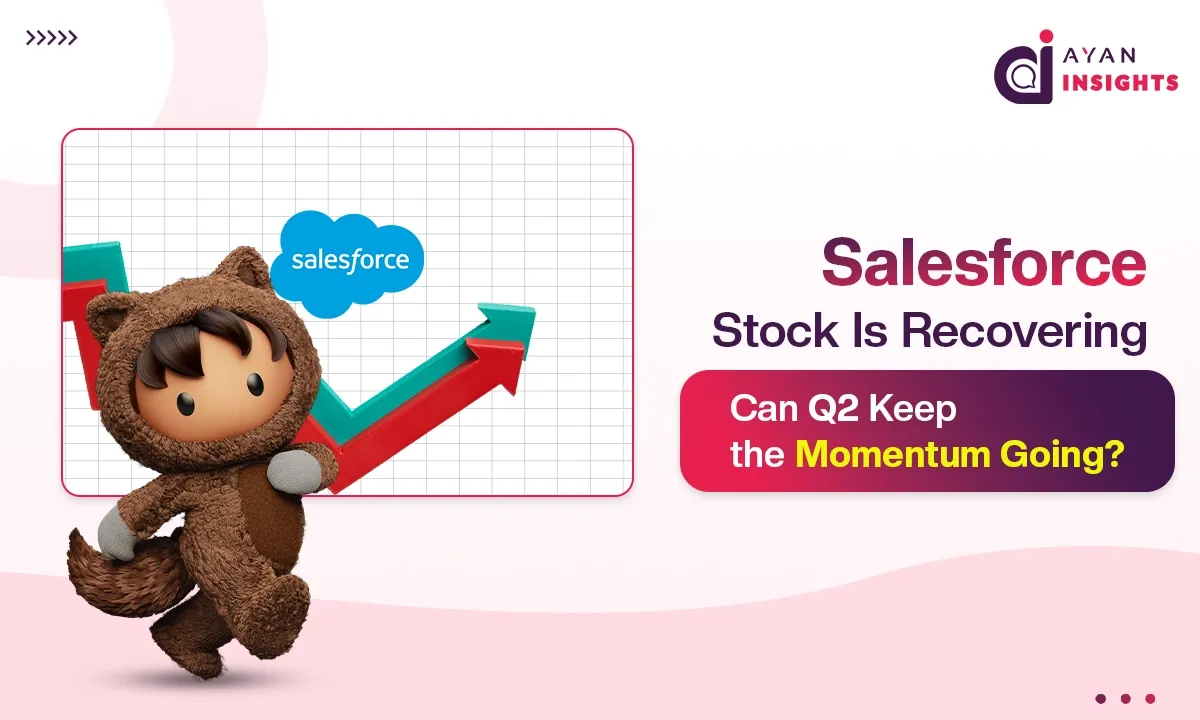
Since then, something interesting has happened. The price climbed back up, quite a lot actually, more than 25%. But now Salesforce has to prove itself. On August 26, the company will announce how the last three months of business actually went. This is called an earnings report. If the news is good, the stock could keep climbing. If it disappoints people, all those recent gains could vanish just as fast as they showed up.

So let’s slow down and understand why people got scared, why they calmed down, and what might happen next.

Why Did the Stock Crash in the First Place?

There’s a fear going around the tech world that people have started calling the SaaSpocalypse. A dramatic name, but the idea behind it is actually pretty easy to understand. Salesforce makes most of its money by selling seats. Think of a seat as one login for one employee. If a company has 500 employees using Salesforce, they’re basically paying for 500 seats.

Now here’s where AI comes in. AI has gotten really good, really fast. And some investors started asking a scary question: what if AI tools can now do the work that used to need 10 employees? If that happens, why would a company keep paying for 10 logins? They might only need one.

Fewer logins sold means less money for Salesforce. If this issue comes up during the Q2 earnings call the stock might fall fast. Debt-funded buybacks add risk: Salesforce borrowed around $31 billion to buy back shares. Even though the buyback is good, for shareholders the company now has debt to handle. This becomes a problem if profits or growth slow down.

Why Did the Stock Crash in the First Place?

There’s a fear going around the tech world that people have started calling the SaaSpocalypse. A dramatic name, but the idea behind it is actually pretty easy to understand. Salesforce makes most of its money by selling seats. Think of a seat as one login for one employee. If a company has 500 employees using Salesforce, they’re basically paying for 500 seats.

Now here’s where AI comes in. AI has gotten really good, really fast. And some investors started asking a scary question: what if AI tools can now do the work that used to need 10 employees? If that happens, why would a company keep paying for 10 logins? They might only need one.

Fewer logins sold means less money for Salesforce. If this issue comes up during the Q2 earnings call the stock might fall fast. Debt-funded buybacks add risk: Salesforce borrowed around $31 billion to buy back shares. Even though the buyback is good, for shareholders the company now has debt to handle. This becomes a problem if profits or growth slow down.

Why Did the Stock Bounce Back?

By August, the price had climbed back up to around $190 to $200. Here’s what actually happened, explained simply.

People started moving their money around. Think of investing like water flowing between different buckets. Earlier in the year, a lot of money was flowing into flashy AI companies, the ones building the actual chips and data centres behind AI. As that trend cooled off a little, some of that money flowed into steadier, more established companies instead. Salesforce, even with all its problems, ended up being one of the places that money landed.

The scary AI prediction just hasn’t come true yet. Remember that fear about AI replacing employee logins? As other software companies reported their numbers throughout the year, nobody found real proof that this was actually happening at scale. That doesn’t mean it will never happen. But no proof was enough to calm people down for now.

Salesforce landed some big, dependable customers, including the U.S. government. The company signed a $1.6 billion, three-year deal with the Department of Veterans Affairs, the agency that supports military veterans. This came on top of an earlier $5.6 billion deal with the U.S. Army. Government contracts are seen as very safe money. Unlike a struggling business, the government isn’t going to suddenly cancel its software overnight. This gave investors a real reason to feel a bit more confident.

Why August 26 Matters So Much

Every three months, companies like Salesforce have to open their books and show everyone exactly how much money they made. This happens on August 26 this time around.

Here’s the tricky part. The stock has already jumped up more than 25% because people are expecting good news. That means Salesforce now has to actually deliver that good news, not just hint at it. If the report comes out just okay, that might not be enough anymore. People will feel let down, even if the numbers technically aren’t bad.

Wall Street has a phrase for this exact situation: buy the rumour, fear the result. It basically means people bought the stock hoping for good news, and now everyone is a little nervous about whether reality will actually match that hope.

Here’s what people will specifically be watching for on August 26.

Is business actually speeding up, or just staying steady? Salesforce told investors that growth should pick up in the second half of the year. People want proof of that, not just promises.

Is the AI product really making money from people using it, or just from signed contracts? Salesforce has an AI assistant tool for businesses called Agentforce. Getting a company to sign up for it is one thing. Getting them to actually use it every day, and pay Salesforce steadily for that usage, is a completely different thing. Investors want to see the second one.

Are two of Salesforce’s older products still struggling? Two of its tools, Tableau and Commerce Cloud, have been weak spots lately. People want a real plan to fix them, not just an acknowledgement that they exist.

Is Salesforce handling its debt responsibly? The company recently borrowed a large sum, over $30 billion, to buy back its own shares. This is a common move companies make to show confidence and boost their stock price. But borrowing that much also means more debt to pay off, so investors want to make sure profits stay strong enough to handle it comfortably.

The Bull Case Heading Into Earnings

Despite the caution, there are still several reasons to feel positive about Salesforce.

Analyst sentiment is positive: Most analysts covering Salesforce still rate the stock as a Buy. Their average 12-month price target is around 242–255, which suggests they believe the stock can rise further. UBS, Wells Fargo, JPMorgan, and Monness have also recently increased their price targets.

Valuation is still relatively cheap: Even after the recent recovery, Salesforce’s forward P/E is still in the low-to-mid teens. This is lower than many other software companies. For a company that makes strong profits and generates good cash flow, that makes the stock look relatively inexpensive.

Government and public-sector momentum is strong: Salesforce is getting major government contracts, including deals with the U.S. Army and through Missionforce. This gives the company another source of steady growth, separate from the concerns around AI and private-sector customers.

The buyback is helping shareholders: Salesforce is buying back its own shares under a $50 billion authorisation. With fewer shares in the market, each remaining share can become more valuable. The buyback has also helped support the stock during its recent recovery.

The Bear Case: Why the Margin for Error Has Shrunk

There are also some important reasons investors should remain careful.

The rally may have already priced in the good news: Salesforce’s stock has already risen more than 25% from its lows. That means investors are now expecting strong results. If the earnings report is only average, the stock could fall because expectations are already high.

The seat-compression fear hasn’t actually been resolved: The concern that AI could reduce the number of Salesforce licenses companies need has not disappeared. There simply hasn’t been enough evidence yet to prove that it is happening. If this issue comes up during the Q2 earnings call the stock might fall fast.

Debt-funded buybacks add risk: Salesforce borrowed around $31 billion to buy back shares. Even though the buyback is good, for shareholders the company now has debt to handle. This becomes a problem if profits or growth slow down.

Institutional conviction isn’t universal: Not all large investors agree about Salesforce’s future. Some have reduced or sold their holdings while others have continued buying. This shows that investors are still divided about where the stock goes from here.

Timeline of Key Events Happened in 2026

Timeline Key Events
Late 2024

Salesforce’s stock hits its highest ever price.

Early 2026 Fear about AI replacing software jobs spreads across the entire tech industry, and Salesforce’s stock begins falling.
May 2026 Salesforce reports decent results, but its prediction for the upcoming months disappoints some investors.
June 17, 2026 The stock hits its lowest price in three years, at $157.74.
July 2026 Salesforce signs the big $1.6 billion government deal with the Department of Veterans Affairs.
Late July to August 2026 The stock climbs steadily back up as fears ease and the government deal boosts confidence.
August 26, 2026 Salesforce announces its next quarterly results, the moment that decides what happens next.

Conclusion

Nothing has really been proven yet, not the good story, and not the bad one either. Investors simply got a little less scared over the past two months and started buying the stock again. Part of that came from money shifting around the market, and part of it came from genuinely good news, like the government contracts.

But hope isn’t the same as proof. On August 26, Salesforce has to show real numbers that actually back up all this optimism. If it does, this comeback could turn into a real, lasting turnaround. If it doesn’t, if growth looks slow, or if the AI job replacement fear comes back into the conversation, the stock could give back a big chunk of what it just gained.

Either way, this is shaping up to be one of the most important earnings reports of the year for anyone who works with, invests in, or simply keeps an eye on Salesforce.

Also Read

How useful was this post?

Click on a star to rate it!

Average rating 0 / 5. Vote count: 0

No votes so far! Be the first to rate this post.

Written by

Priya Bansal

Salesforce Technical Architect - Lightning (Aura & LWC) Specialist | Pardot | Salesforce Integrations | Sales/Service/Community Cloud Expert | Salesforce Apps (AppExchange) Developer

Get the latest tips, news, updates, advice, inspiration, and more….

Contributor of the month
contributor
Akash P T

Salesforce Developer with 1.8+ years of experience in Apex, LWC, Flows, REST API integrations and Agentforce. Passionate about automation, scalable CRM solutions, and sharing Salesforce knowledge with the community.

...
Categories
...
Boost Your Brand's Visibility

Want to promote your products/services in front of more customers?

...

Leave a Reply

Your email address will not be published. Required fields are marked *