Salesforce Open CTI Sunset: Moving Toward Next-Gen Contact Centers with Agentforce

May 05, 2026
14 Views
Salesforce Open CTI Sunset: Moving Toward Next-Gen Contact Centers with Agentforce
Summarize this blog post with:

The enterprise software ecosystem is experiencing a profound shift in how customer communications are managed and resolved. Salesforce has officially placed its longstanding browser-based telephony integration into maintenance mode, setting a definitive shutdown date of February 28, 2028. For IT directors and service operations leaders, the Salesforce Open CTI end of life is a critical inflection point. It signals the end of simple, reactive call logging and the beginning of a highly autonomous, deeply integrated era of customer support.

If you observe the underlying trends driving this change, the motivation is clear. Industry forecasts indicate that artificial intelligence is on pace to independently handle up to 50% of routine customer service inquiries by the year 2027. Organizations that attempt to coast on legacy infrastructure will find themselves unable to compete with the speed and personalization of modernized competitors. Navigating the Open CTI retirement is your opportunity to fundamentally rewire your support operations for the future.
The Data Visibility Problem in Legacy Architecture

To understand why a new paradigm is necessary, we have to look at the mechanical limitations of the outgoing framework. For years, Open CTI was the standard because it successfully decoupled the CRM from local desktop phone software. It allowed organizations to link external telecom hardware, like Avaya or local PBX systems to the browser interface using custom JavaScript.

However, this architecture relies on a massive blind spot. In a legacy setup, the audio streams, the interactive voice response (IVR) logic, and the call recordings live exclusively within the external telephony provider’s servers. The CRM is only fed a thin layer of metadata, such as the caller’s phone number and the duration of the conversation.

Because Salesforce is denied access to the live interaction, it cannot apply real-time intelligence. The system only knows a call happened after it has already concluded. As the Salesforce Open CTI sunset approaches, maintaining this fragmented, delayed data flow completely prevents organizations from leveraging modern automated tools.

Building the Agentforce Contact Center

The technological successor to this legacy framework is designed around data unification. By transitioning to a native architecture powered by Salesforce Voice and Agentforce, organizations eliminate the external bridge entirely. Voice interactions are ingested, processed, and stored directly within the CRM as native data objects.

This centralized approach is the foundation of the modern AI powered contact center Salesforce environment. When the intelligence engine has access to the live audio stream, artificial intelligence transforms from a post-call analytics tool into an active, real-time participant in the conversation.

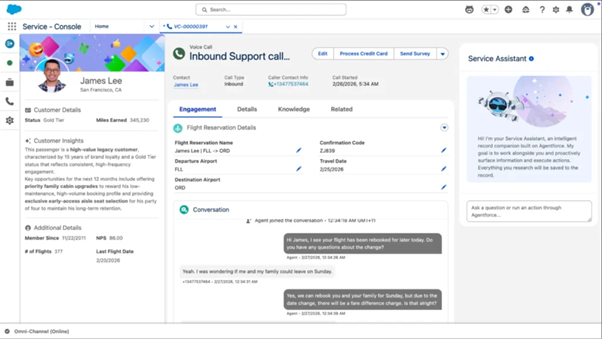
The Agentforce contact center operates by silently monitoring live calls. As the customer speaks, the system transcribes the dialogue, analyzes the emotional sentiment, and instantly surfaces relevant troubleshooting guides or policy documents on the representative’s screen. The scale of this technology is already proven, with Salesforce reporting that its native AI tools have successfully managed over 2 million complex interactions on the Salesforce Help portal alone.

Picture1

Salesforce Service Console, image from Salesforce.

The Orchestration Solution for Complex Enterprises

While transitioning to a fully native, cloud-based voice solution is highly efficient, it presents a massive logistical hurdle for global enterprises. Many large-scale operations are locked into multi-year contracts with major telecom carriers or possess localized, on-premise hardware designed to meet strict regional data compliance laws. They cannot simply discard millions of dollars of existing infrastructure.

For these complex environments, building a Salesforce AI contact center requires a strategic middle ground: the enterprise voice orchestration layer.

Instead of a “rip-and-replace” approach, companies can deploy advanced middleware to act as a synchronization engine. This layer sits seamlessly between the existing telephony providers (such as Cisco or Microsoft Teams) and the CRM. The external carriers continue to handle the heavy lifting of voice delivery, while the orchestration layer actively pushes the live audio and caller data into Salesforce’s intelligence engine.

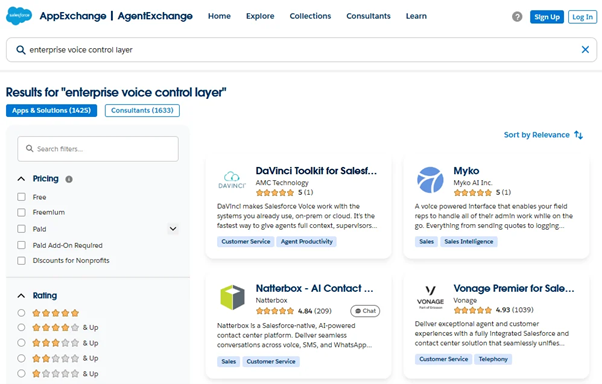
By utilizing robust integration platforms, such as the DaVinci Voice Toolkit by AMC Technology, organizations can preserve their localized telecom investments while simultaneously feeding live data into Agentforce. This hybrid model is how massive enterprises successfully build an AI contact centre Salesforce architecture without violating existing vendor agreements or compliance standards.

Picture2

Enterprise voice control layer solutions on AppExchange

The Operational Reality on the Service Floor

The ultimate goal of upgrading this infrastructure is to transform the daily workflow of the human representatives. Today’s consumers are highly demanding, with 76% expecting immediate, personalized service the second their call connects.When you replace legacy adapters with a synchronized intelligence layer, the agent’s workspace becomes proactive. Background identity authentication triggers instantly, meaning the agent greets the caller with their active support ticket already open on the screen. Routine administrative burdens, like logging wrap-up codes or manually typing out case summaries are entirely automated by the AI.

Anyone tracking recent call center AI news can see the direct impact of these capabilities. A staggering 93% of customer service professionals acknowledge that integrated artificial intelligence actively saves them time during their shifts. Furthermore, representatives operating within these modernized environments report spending 20% less time bogged down in repetitive, routine case administration.

Strategic Planning for the Transition

Executing this architectural shift requires precision and foresight. As you prepare for the Salesforce Open CTI retirement, IT leaders must move away from patching old code and focus on foundational data strategy.

  1. Audit Your Data Flow: Begin by mapping exactly what information currently passes between your external telephony provider and the CRM. Identify the custom screen-pop rules and JavaScript workflows that will break when the legacy framework is taken offline.
  2. Determine Your Connectivity Strategy: Evaluate your current carrier contracts and hardware investments. Decide whether your organization will benefit most from a fully native migration to Salesforce Voice, or if an enterprise orchestration layer is necessary to protect your existing telecom assets.
  3. Execute Iterative Deployment: Do not attempt a universal cutover. Deploy the new integration layer and activate the real-time Agentforce transcription for a controlled, isolated group of service agents. Utilize their live feedback to calibrate the AI’s suggested responses and automated workflows before scaling the solution across your entire support organization.

Conclusion

The mandated retirement of traditional telephony adapters is a necessary catalyst for industry-wide innovation. Continuing to rely on decoupled systems leaves support teams struggling with delayed data and reactive workflows. By strategically transitioning to an AI-driven architecture, either natively or through a robust orchestration layer, organizations can finally break down historical data silos. Treating this transition as a fundamental operational upgrade ensures your contact center is equipped to deliver the high-speed, intelligent resolution that the modern market demands.

How useful was this post?

Click on a star to rate it!

Average rating 0 / 5. Vote count: 0

No votes so far! Be the first to rate this post.

Written by

Dorian Sabitov

Dorian Sabitov is a 6x Certified Salesforce Administrator and Developer with extensive experience in customizing Salesforce to the client's needs. He started his journey in IT as a CRM admin and kept his focus on the Salesforce ecosystem. He loves exploring new integrations in Salesforce and spotting alternative ways to optimize business processes inside the CRM.

Get the latest tips, news, updates, advice, inspiration, and more….

Contributor of the month
contributor
Mykyta Lovygin

SFCC Developer | SFCC Technical Architect | Salesforce Consultant | Salesforce Developer | Salesforce Architect |

...
Categories
...
Boost Your Brand's Visibility

Want to promote your products/services in front of more customers?

...

Leave a Reply

Your email address will not be published. Required fields are marked *