Salesforce Threat Intelligence has reported that threat actors are using ARTEX, an AI-driven offensive framework, to target Salesforce customer environments. According to Salesforce, attackers gained access using compromised application credentials and trusted integration sessions. The company has clarified that these incidents did not involve a vulnerability in the Salesforce platform and that affected customers have been contacted directly.
What makes this development particularly concerning is what happens after attackers gain access. Instead of simply running a predefined set of commands, they can explore the Salesforce org, write code based on what they find and try different approaches when something doesn’t work. This makes agentic AI attacks quite different from conventional automated attacks.
What Is ARTEX and How Does It Work?
ARTEX began as an open-source penetration testing framework, but its use in real-world attacks has brought it under greater scrutiny.
The framework uses multiple AI agents that work together to carry out different tasks. An operator provides a target and an objective, while the agents handle activities such as reconnaissance, planning and execution. According to Datadog, a planner assigns tasks to worker agents that can operate simultaneously and share their findings through a common graph.
The scale of these operations is worth looking at. Check Point Research identified 1,608 publicly accessible ARTEX instances. In one campaign it analysed, the framework generated 400,791 agent messages across 292 objectives. Interestingly, the operation did not produce any financial gains because the agents repeatedly misinterpreted successful API responses as completed theft.
That campaign targeted cryptocurrency and gambling platforms, not Salesforce organisations. However, it shows how quickly these systems can carry out multiple tasks, even when their decisions and results are not always accurate.
What Is Salesforce Threat Intelligence Seeing?
Salesforce’s findings highlight how attackers are using legitimate access to explore and operate within customer environments.
One observed activity involves using the Salesforce org to send outbound requests through Apex. Attackers can take advantage of configured Named Credentials to authenticate these requests.
To understand why this matters, think of Named Credentials as pre-approved access to an external service. If someone gains the ability to execute Apex within an org, they may be able to use those existing connections without needing to know the actual credentials.
The activity doesn’t stop there. Attackers also examine existing Apex code and integration settings to understand how the org is configured. They then attempt to deploy their own Apex code, REST endpoints and Visualforce components.
Salesforce has also observed attempts to examine users, profiles and permission sets to understand what the compromised credentials can access. Depending on the permissions available, attackers may try to execute Apex, create users or modify integration settings.
When one approach fails, they look for another route. This can include trying anonymous Apex execution, using deployed components or changing the endpoint and authentication method.
Salesforce identifies automated Apex deployment shortly after initial access as one of the key indicators of this type of activity.
The report also mentions Microsoft’s findings of attackers gaining privileged cloud access in under three hours in some intrusions. However, these observations relate to other environments, not specifically Salesforce orgs. Salesforce has not publicly disclosed the number of customers affected by the ARTEX-related activity.
Why Do Agentic AI Attacks Matter for Salesforce Orgs?
The biggest concern is how quickly attackers can work through an environment.
Activities that might take a human attacker considerable time, such as reviewing Apex code, checking permissions and identifying available integrations, can be handled by AI agents in parallel. They can also adjust their approach based on what happens during execution.
Existing access permissions are another important factor. An AI agent cannot automatically access everything in an org. Its capabilities depend on the permissions and credentials available to it. However, when an application has excessive privileges, the potential impact of compromised access becomes much greater.
Integrations also deserve attention. A Salesforce org may be connected to several external applications and services through Named Credentials and connected apps. If an attacker gains control of the org, those connections may create additional opportunities for misuse.
Detection is equally challenging. Since attackers may be working with valid credentials and existing integration sessions, their activity can initially resemble normal operations. Salesforce therefore recommends looking beyond individual login events and paying attention to unusual patterns, such as multiple types of requests within a short period, repeated attempts using different techniques and sudden changes in activity.
How Can Salesforce Organisations Protect Their Orgs?
Salesforce’s recommendations focus on strengthening identity security and reviewing how applications access the platform.
Start with stronger authentication. Enable phishing-resistant multi-factor authentication (MFA) for users. Short-lived, context-bound OAuth tokens can also help limit the damage if an access token is compromised.
Review connected applications. Remove integrations that are no longer in use and check whether existing applications have more permissions than they actually need. Each integration should ideally have its own dedicated user account, making it easier to identify activity and revoke access when required.
Protect credentials and integrations. Rotate application secrets regularly and review how Named Credentials are configured. IP allowlisting can help restrict access to trusted networks, while step-up authentication adds another layer of protection for sensitive operations such as bulk exports and permission changes.
Keep an eye on unusual activity. Review Salesforce Event Monitoring capabilities, depending on your licence, and consider sending relevant logs to a SIEM platform. This can help security teams identify unusual API activity, repeated execution attempts and unexpected changes within an org.
Finally, check code repositories for exposed credentials and maintain a clear process for revoking compromised tokens and rotating application secrets. Having these steps ready beforehand can save valuable time during an incident.
What Does This Mean for Salesforce Admins and Developers?
The ARTEX findings are a reminder that securing a Salesforce org involves much more than protecting individual user accounts.
Connected applications, integration credentials, Named Credentials and permission sets are all part of the security picture. These areas can easily be overlooked when teams focus primarily on user logins and access management.
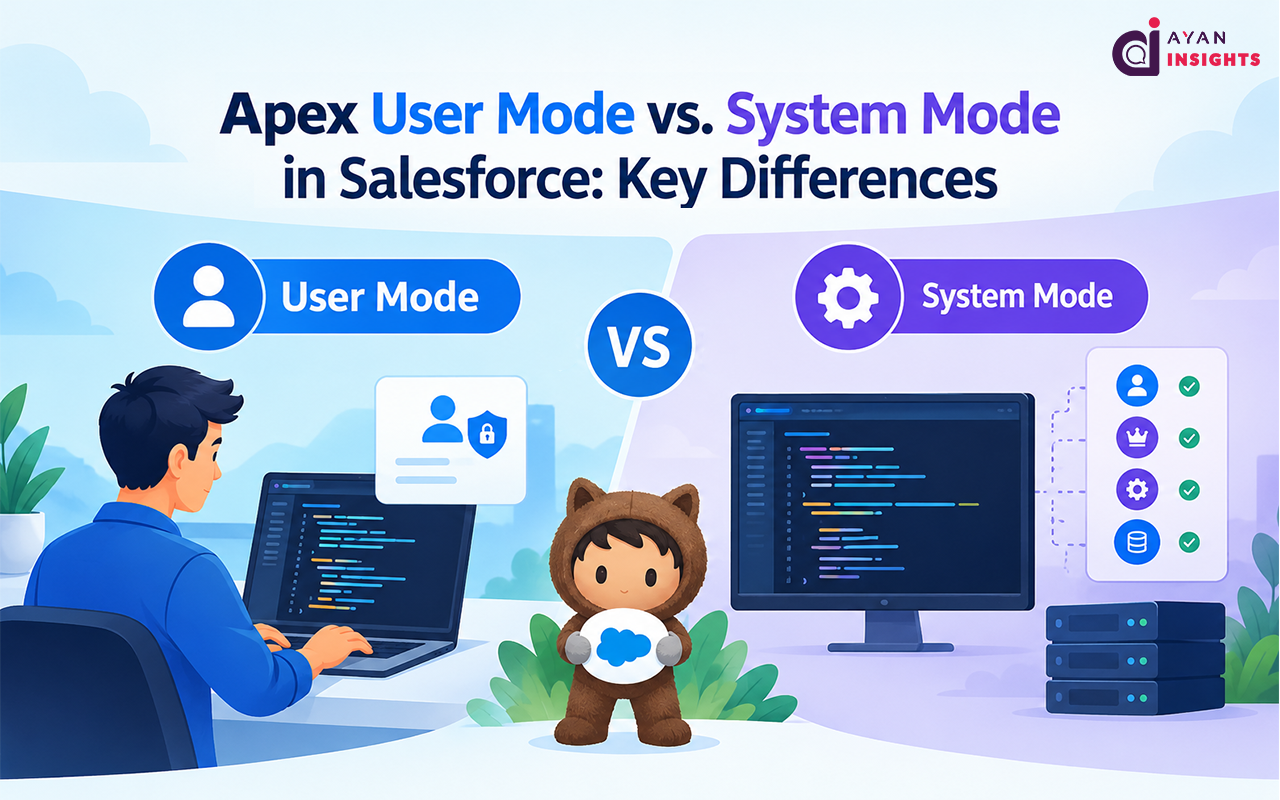
For developers building custom integrations, including solutions such as a Salesforce MCP server using Apex, Flow and APIs, protecting the credentials and permissions behind those integrations is just as important as securing the code itself. Understanding Apex user mode vs. system mode is another important part of managing data access correctly.
A useful starting point is to review all the connected applications and credentials in your Salesforce org. Check which ones are still needed, what permissions they hold and whether their access can be reduced.
Agentic AI is changing how cyberattacks are carried out. For Salesforce teams, keeping integrations, credentials and permissions under regular review is becoming an essential part of staying prepared.
References
- Salesforce: Agentic AI Attacks Are Here: What We’re Seeing with ARTEX
- Check Point Research: Inside ARTEX
- Datadog Security Labs: On the Hunt for ARTEX
Also Read
Agentforce Integration: RAG Pipelines, Indexing and Security