Imagine an e-commerce company.
A customer types:
“My order hasn’t arrived, and I’d also like to cancel my extended warranty.”
Although it looks like one request, there are actually two separate tasks.
The system should automatically identify both intents.
The first request belongs to the Order Support Agent.
The second belongs to the Warranty Agent.
Instead of making the customer contact two different departments, Agentforce intelligently routes each task to the appropriate specialized agent while maintaining a single conversation.
This creates a much smoother customer experience.
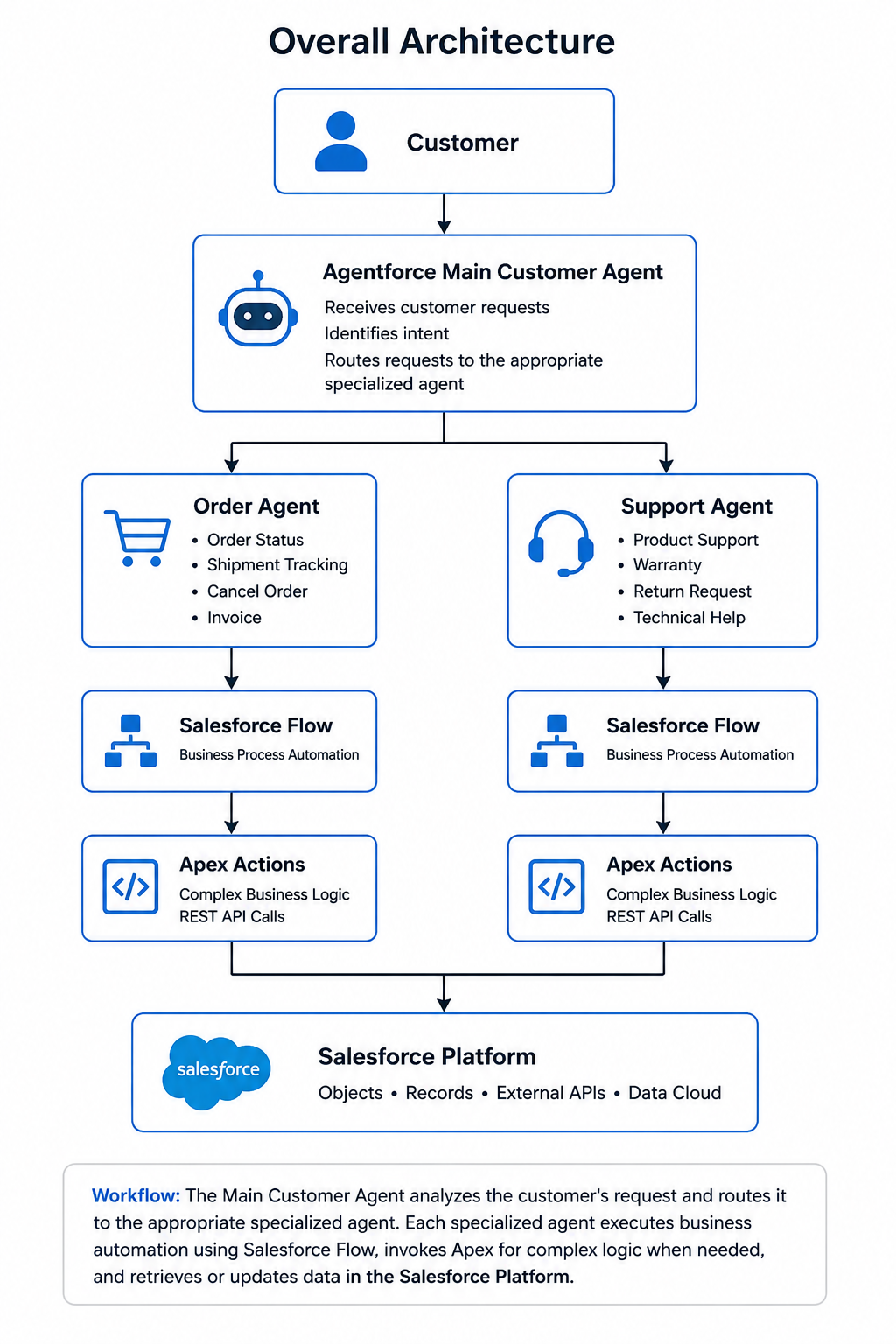
Customer
│
▼
Natural Language Query
│
▼
Agentforce Main Customer Agent
(Understands Intent & Routes Request)
│
├──────────────────────────────┐
Order Agent
(Order-related requests)
│▼
Examples
• Order Status
• Track Shipment
• Cancel Order
• Invoice
│
▼
Salesforce Flow
(Business Process Automation)
│
▼
Apex Actions
(Complex Logic / API Calls) |
Support Agent
(Support-related requests)
│▼
Examples
• Product Issues
• Warranty
• Return Request
• General Help
│
▼
Salesforce Flow
(Business Process Automation)
│
▼
Apex Actions
(Complex Logic / API Calls) |
└──────────────────────────────┘
▼
Salesforce Platform
Objects • Records • External APIs • Data Cloud
- Agentforce understands customer intent.
- Flow orchestrates business logic
- Apex performs advanced operations that require custom code.
Each layer has a clear responsibility, making the overall solution easy to maintain.
Step 1: Create Specialized Agents
Rather than creating one universal AI assistant, build dedicated agents for specific business domains.
For example:
Order Support Agent
Responsibilities:
- Track orders
- Update delivery status
- Estimate shipping dates
- Handle order modifications
Billing Agent
Responsibilities:
- Generate invoices
- Explain charges
- Process refunds
- Handle payment failures
Technical Support Agent
Responsibilities:
- Troubleshoot products
- Suggest knowledge articles
- Create support cases
- Escalate critical issues
Customer Account Agent
Responsibilities:
- Reset passwords
- Update profile information
- Manage subscriptions
- Verify customer identity
Each agent focuses on doing one job exceptionally well instead of trying to solve everything.
Step 2: Let Flow Handle Business Automation
Once Agentforce identifies the customer’s intent, it can invoke a Salesforce Flow.
Flow acts as the orchestration engine.
For example:
Customer says:
“Where is my order?”
The Order Agent launches a Flow that:
- Finds the Order record
- Retrieves shipment details
- Checks delivery status
- Formats the response
- Returns the result back to Agentforce
No Apex is required for this simple automation.
Step 3: Use Apex for Complex Logic
Some business requirements are too advanced for Flow alone.
This is where Apex becomes valuable.
Examples include:
- Calling external shipping APIs
- Complex validation rules
- AI scoring algorithms
- Dynamic pricing calculations
- Processing large datasets.Flow can simply invoke an Apex Action whenever additional processing is required
This keeps Flows clean while allowing developers to implement sophisticated business logic.