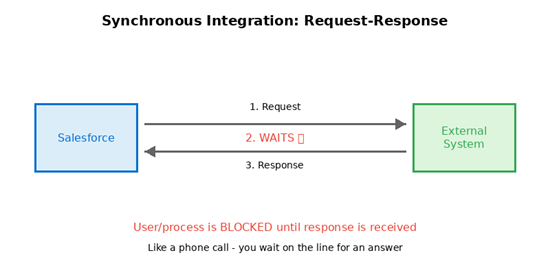
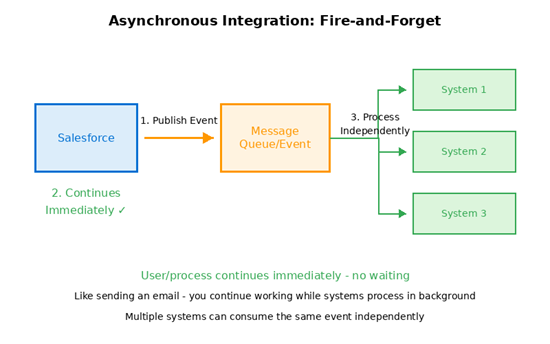
Consider how you communicate in your day-to-day life. When you want a quick response, like to find out whether a colleague is available for a meeting immediately, you phone them. You hold the line for their answer before you make the next move. But for the types of interactions where you have information to convey but don’t need an immediate response, a detailed project update, for example, you fire off an email and get on with your day, confident that they’ll reply when they can.
This basic difference of phone calls versus emails is echoed in one of the most important design decisions in salesforce integrations: deciding between synchronous and asynchronous communication styles. In the same way you wouldn’t call someone at 3 AM about a question that’s not urgent, don’t make your systems wait in real time for processes that can run behind the scenes.
In this guide, we’ll explore the complete landscape of Salesforce integration patterns, with a deep dive into synchronous vs asynchronous approaches, complete with real-world use cases from financial services and manufacturing industries.