Understanding Waterfall Segments in Salesforce Marketing Cloud Engagement

March 30, 2026
164 Views
Understanding Waterfall Segments in Salesforce Marketing Cloud Engagement
Summarize this blog post with:

Segmentation in Salesforce Marketing Cloud Engagement (SFMC) is vital to personalised and targeted communication. However, one of the most powerful and yet confusing segmentation methods available to marketers is Waterfall Segmentation. Understanding how waterfall segments work can help prevent duplication of your audience and optimise your customer journeys.

This blog explains what waterfall segments are, how you use them, when to use them, and implementation best practices.

What is a Waterfall Segment in Salesforce Marketing Cloud?

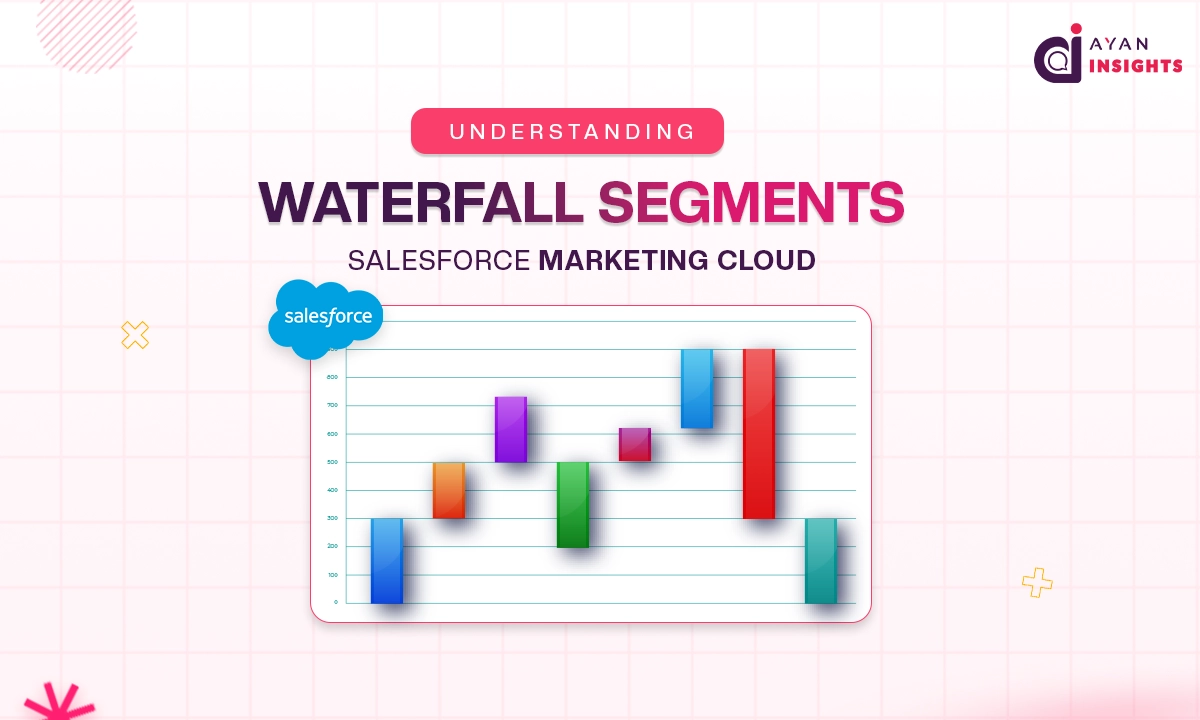
A Waterfall Segment in Salesforce Marketing Cloud Engagement is a method of dividing a large audience into mutually exclusive segments, where records are evaluated sequentially from top to bottom.

Each contact is placed into the first segment whose criteria they meet, and then excluded from all subsequent segments.

This creates a priority-based segmentation structure, ensuring:

  • No duplicate contacts across segments
  • Clear prioritisation of audience groups
  • Controlled campaign targeting
  • Efficient use of data

How Waterfall Segmentation Works?

Segmentation of the waterfall follows a top-down logic.

Step-by-Step Flow

  • Start with the first segment rule
  • Evaluate all records
  • Move matching records into Segment 1
  • Remove those records from the remaining dataset
  • Evaluate the next segment
  • Continue until all segments are processed

Example of Waterfall Segmentation

Imagine you are creating segments for an email promotion campaign.
Segment Priority Order:

Segment 1 — High Value Customers
• Purchase Amount > ₹50,000

Segment 2 — Recent Customers
• Purchased in the last 30 days

Segment 3 — Inactive Customers
• No purchase in the last 6 months
What Happens?
If a customer:
• Purchased ₹60,000 and
• Purchased in the last 30 days

They will go into:

Segment 1 (High Value Customers)
NOT Segment 2.

Because Segment 1 comes first.

This ensures no duplication and a clear targeting priority.

Why Use Waterfall Segments?

Waterfall segmentation is especially useful when:

1. You Need Priority-Based Messaging
For example:
  • VIP customers receive premium offers
  • Regular customers receive standard promotions
  • Inactive users receive re-engagement campaigns
Priority matters; waterfall logic handles this perfectly.
2. To Prevent Duplicate Messaging
Without waterfall logic, the same contact might:
  • Receive multiple emails
  • Enter multiple journeys
  • Cause customer frustration
Waterfall segments ensure each contact belongs to only one group.
3. To Control Audience Allocation
Useful when:
  • Running A/B campaigns
  • Managing budget-based sends
  • Controlling send volume

Where Waterfall Segments Are Used in SFMC

Waterfall segmentation is commonly implemented using:

1. Automation Studio
Inside Query Activities, waterfall logic is created using:
  • Sequential SQL queries
  • Exclusion logic
  • Temporary data extensions
Priority matters; waterfall logic handles this perfectly.
2. Contact Builder
You can build structured data relationships that support waterfall logic.
3. Journey Builder
Segments created through waterfall logic can be used as:
  • Entry sources
  • Decision splits
  • Targeted journey paths

How useful was this post?

Click on a star to rate it!

Average rating 0 / 5. Vote count: 0

No votes so far! Be the first to rate this post.

Written by

Mohit Bansal

Salesforce Technical Architect | Lead | Salesforce Lightning & Integrations Expert | Pardot | 5X Salesforce Certified | App Publisher | Blogger

Get the latest tips, news, updates, advice, inspiration, and more….

Contributor of the month
contributor
Mykyta Lovygin

SFCC Developer | SFCC Technical Architect | Salesforce Consultant | Salesforce Developer | Salesforce Architect |

...
Categories
...
Boost Your Brand's Visibility

Want to promote your products/services in front of more customers?

...

Leave a Reply

Your email address will not be published. Required fields are marked *